

Training power line technicians in Cape Breton
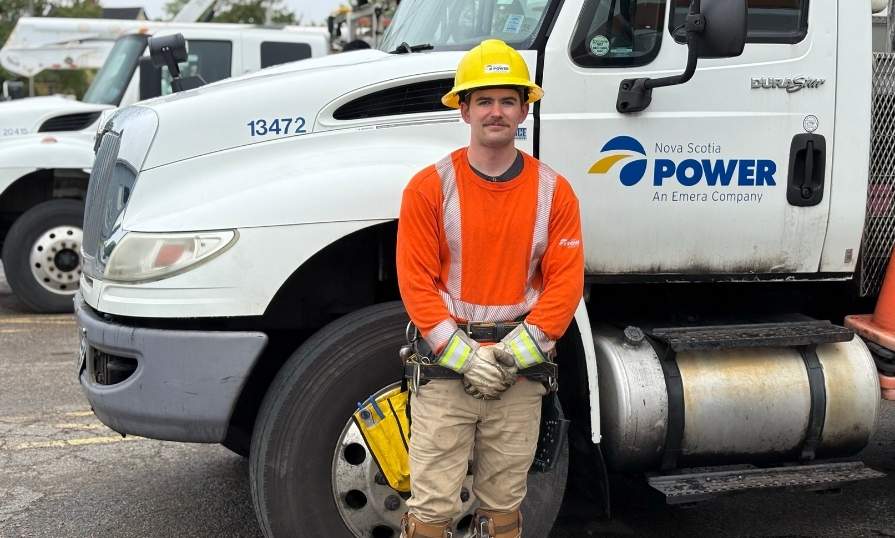
When Colin Walker isn’t climbing poles or studying in the classroom, you’ll likely find him fishing along Cape Breton’s coastline. It’s a place he now calls home and one where he’s building a new career, thanks to locally delivered training that is helping meet a growing workforce need.
Originally from Mount Uniacke, Colin spent several years living in larger cities before deciding to settle in Cape Breton for its strong sense of community and pace of life. Today, he’s enrolled in the Power and Utility Line Work program delivered at NSCC Sydney Waterfront Campus in partnership with Nova Scotia Power. This model is designed to train skilled workers where they are needed most.
“I’ve lived in cities like Ottawa and Halifax, but the older I get, the more I appreciate being somewhere rural,” says Colin.
Responding to local workforce needs
The program was developed in direct response to industry demand. It brings training to Cape Breton instead of requiring learners to leave their communities.
“Utility line workers are essential to serving our customers today and building the clean energy grid of tomorrow,” says Dave Pickles, Chief Operating Officer, Nova Scotia Power. “Expanding the program to the Sydney Waterfront Campus helps meet growing workforce needs while creating more opportunities for people in Cape Breton to train and work closer to home.”
That local access was critical for Colin. “If this program wasn’t offered in Cape Breton, I don’t think I’d be in it,” he says. “Logistically, it just wouldn’t have worked.”
By removing barriers to training, the program helps learners stay in their communities and supports employers in building a workforce that is rooted locally. Many students travel from across Cape Breton and plan to return home after graduation.
“We have people from places like Margaree and Judique,” Colin says. “A lot of them want to go back and work in those communities. That’s why they’re here.”
A classroom built with industry
A key strength of the program is its close connection to industry. Students learn from instructors with real world experience at Nova Scotia Power and train in an environment designed to mirror the job.
“They can tell you exactly what circuits look like in places across Cape Breton,” Colin says. “That kind of knowledge is huge.”
With support from Nova Scotia Power, the campus features a fully equipped pole yard where students train multiple times a week using industry standard tools and equipment, including bucket trucks.
“We’re up there two to three times a week,” says Colin. “We’re using the same equipment we’ll use in the field.”
For faculty member Sean MacSween, seeing that hands on learning translate into confidence is a highlight.
“I love seeing students build confidence as they transition from learning fundamentals to performing more complex tasks,” he says. “Watching them work as a team and apply their knowledge safely really captures what the program is all about.”
Intensive, hands-on, career-ready
Colin describes the program as the most immersive learning experience he’s had. The schedule blends theory with constant hands-on practice, pushing students to quickly build both skill and confidence.
“You’re in class learning theory, then you go home and keep studying, and then you’re in the pole yard applying it,” he says. “It’s constant, but in a good way.”
With a background in policy and customer relations, including a Bachelor of Arts and a master’s in public administration, Colin’s path to the trades reflects a broader shift toward hands-on careers.
“It takes a lot to get comfortable with even basic tasks,” he says. “Climbing, positioning, installing equipment, it all takes repetition. My respect for the trade has gone up significantly.”
A diverse cohort, united by purpose
Colin is part of a cohort of 28 students with a wide range of backgrounds, from recent high school graduates to career changers. That diversity reflects the growing appeal of skilled trades and the shared understanding that the work depends on teamwork.
“You can’t really do this job alone,” he says. “When you’re up on the pole, you rely on your team on the ground.”
Building careers and communities
After graduation, Colin hopes to secure an apprenticeship and work toward becoming a Red Seal power line technician, ideally staying in Cape Breton.
His story highlights the broader impact of delivering training locally. It helps individuals build meaningful careers while strengthening the communities they call home.
“For me, it all adds up,” he says. “I enjoy being outside, working with people and doing something that matters.”
His advice to others considering the program is simple: be a good teammate, ask questions and be willing to push yourself. “It can feel uncomfortable at first, but that’s how you get better.”