

From classroom to shipyard: Building Nova Scotia’s marine trades
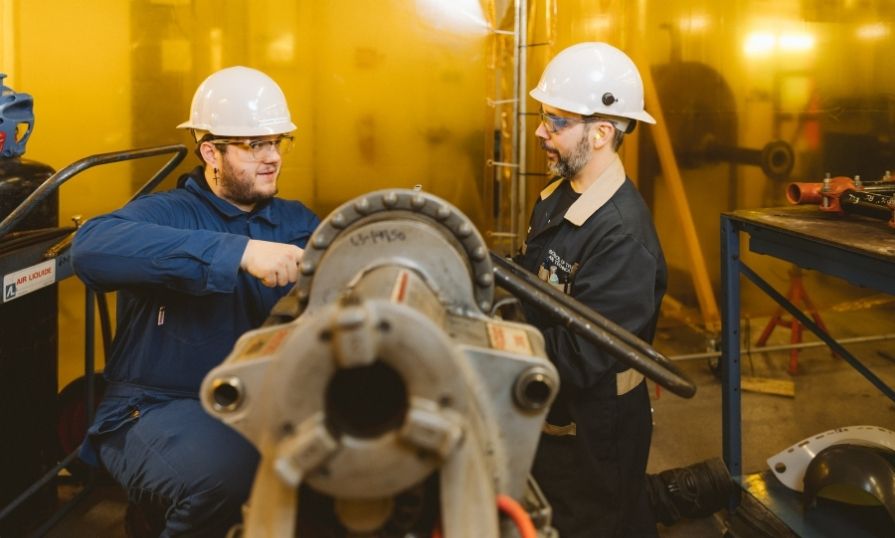
When Keighan Thibodeau walks through the Irving Shipbuilding yard, he feels small. That’s part of what excites him.
You’re dealing with ships that are 50 times the size of anything you’ve ever worked on,” he says. “You’re crawling in and out of them like a little ant. It’s fascinating. And honestly, a little intimidating but in a good way.”
Born and raised in Halifax, Keighan has always been someone who learns best with his hands. After graduating high school, he spent several years working before returning to school in his mid-20s with renewed focus and purpose.
Keighan is a student in the Irving Shipbuilding Marine Trades Initiative, a two-year program delivered at NSCC. While he is training in pipe trades, the initiative also includes pathways in welding and metal fabrication, all designed to prepare students for careers in Nova Scotia’s growing marine and shipbuilding sector through fully funded tuition. The program is funded by Irving Shipbuilding as part of its Value Proposition commitments to Canada tied to its shipbuilding contracts.
For Keighan, it is an opportunity that opened a door that might otherwise have stayed closed.
A path that made sense financially and professionally
Keighan had already explored trades training before, entering NSCC’s blended plumbing program straight out of high school and quickly learning how demanding post-secondary education can be at 18. “Some people are ready at that age. Some aren’t,” he says. “I definitely wasn’t.”
What ultimately drew him to the Marine Trades Initiative wasn’t just the work, it was the opportunity. Funded through Irving Shipbuilding, the program covers tuition, tools and equipment, reducing one of the biggest barriers many trades students face.
“Having almost all aspects of the training covered by Irving and not having to worry about loans or saving up that kind of money made a huge difference,” says Keighan.
Learning by doing and seeing it in action
Students spend about half their time in class and half in the shop, developing practical skills across plumbing, pipefitting, welding and industrial systems. For Keighan, one of the most impactful moments came during a job-shadowing placement at Irving Shipbuilding:
“You’re learning about systems in class, looking at pictures or working with small pieces of pipe, and then suddenly you’re seeing those same systems on a massive scale. It really made the work feel real. You also see how many trades and people are involved, all working together.”
That sense of teamwork is foundational in shipbuilding, where pipe trades support everything from fire suppression and water systems to power generation and waste management.
Training for a floating city
According to Flavio Racca, NSCC's first‑year lead instructor for pipefitting in the Marine Trades Initiative, that complexity is exactly why this training matters. “A ship is basically a city on the water,” Racca explains. “It has plumbing, fire protection, steam, power, waste systems — all inside a steel structure.”
The 2-year program exposes students to the full breadth of the pipe trades before they choose a specialty. Graduates leave with approximately 1,800 apprenticeship hours already completed, giving them a significant head start whether they pursue steamfitting/pipefitting, sprinkler systems or plumbing.
“They don’t just learn theory,” says Racca. “They build. They weld. They install. They read blueprints, which is a universal language in this industry.”
Meeting a growing workforce need
The Marine Trades Initiative exists for a reason: demand. With decades of shipbuilding and repair work ahead, Canada’s marine industry requires a highly skilled, job-ready workforce, and NSCC is playing a key role in meeting that need.
“There’s work here for years,” says Keighan. “Any ship being built means jobs. Any ship being repaired means more jobs. This isn’t a trade that’s going away.”
Racca describes the initiative as more than free tuition, but a clear pathway into stable, well-paying careers without leaving the province. “You don’t have to go out west. You can build a life right here in Nova Scotia.”
Building capacity for Canada’s defence sector
NSCC’s partnership with Irving Shipbuilding is part of a larger picture that positions the College as a growing contributor to Canada’s defence sector through skilled trades training and applied innovation.
Recognized nationally for its strength in the trades, NSCC delivers training aligned with workforce demands in the marine manufacturing sector. That reputation is one reason Irving Shipbuilding partnered with the college to deliver fully funded trades programs through the Marine Trades Initiative while also investing in upgraded training spaces at NSCC Akerley Campus.
Beyond shipbuilding, NSCC supports the defence ecosystem through expertise across seven of the country’s 17 Key Industrial Capabilities, aligning its skills, infrastructure and applied research capacity with the evolving needs of defence partners across marine, land, aerospace and space contexts.
Building confidence and futures
While students in the Marine Trades Initiative are not guaranteed jobs with Irving Shipbuilding, the partnership offers meaningful exposure, experience and confidence.
“Knowing Irving is investing in this program tells you the demand is real,” says Keighan.
Whether his path leads to shipbuilding or other industrial work, the training has created options, and that is the heart of NSCC’s role in the initiative: connecting people who learn by doing with meaningful careers that matter to industry, the province and communities across Nova Scotia.