

Global talent, local impact
Date: Oct. 02, 2026
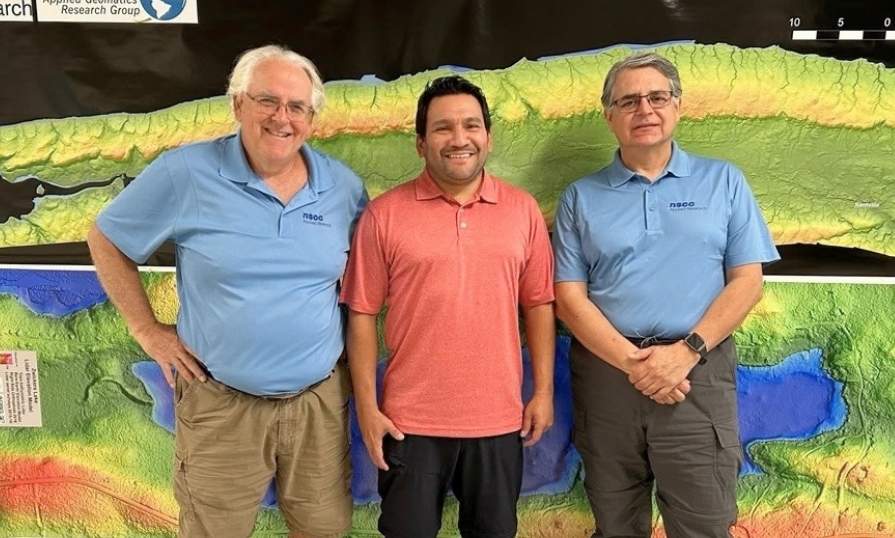
For more than 2 decades, the Applied Geomatics Research Group (AGRG) has helped industry and community partners solve complex challenges through applied research. Along the way, it has helped people from around the world build careers, connections and futures in Nova Scotia.
From mapping coastlines and monitoring environmental change to developing geospatial solutions for partners across Canada, AGRG's work has always been rooted in innovation. But according to Research Scientist Dr. Tim Webster, the group's greatest strength is its people.
At AGRG, researchers bring more than technical skills. They bring different experiences, perspectives and ways of thinking that strengthen both the research and the team behind it.
"It's often the experiences and knowledge people bring in addition to the skills they learn studying at COGS that make them unique,” says Tim. “Those diverse backgrounds strengthen our work, bringing different perspectives and approaches to problem solving while helping us deliver high-quality research for our partners."
Building a new life
For current AGRG researcher Rene Mendoza, that journey began when he left Mexico to pursue a future in geomatics.
After graduating from the Remote Sensing program at the Centre of Geographic Sciences (COGS), Rene joined NSCC Applied Research and eventually found his niche at AGRG, contributing to projects that help better understand and protect coastal environments.
"Moving from Mexico was about building a new life here," says Rene. "AGRG played an essential role in that transition by providing a supportive, high-level professional environment and valuable work experience. That stability allowed me to settle in, connect with the Annapolis Valley community and build a fulfilling life in Nova Scotia."
Today, Rene's connection to Nova Scotia extends well beyond the workplace. Through volunteer work and community involvement, he has built strong roots in the Annapolis Valley.
More than research experience
For Daniel Yabar, AGRG became the next chapter in a career that began in Peru and later took him to Costa Rica, where he completed a master's degree in Watershed Management.
Throughout his work in environmental engineering and natural resource conservation, geomatics was often part of the solution, but never the primary focus. Over time, Daniel realized he wanted to make geomatics the centre of his career, a goal that led him to the Remote Sensing program at COGS and eventually AGRG.
After graduating, he joined the research group, where he was able to combine years of environmental experience with new training in geomatics while contributing to projects tackling real-world environmental challenges.
"AGRG has been much more than my first job after COGS. It has been the place where I have been able to connect my previous professional experience with my new training in geomatics, continue learning and build professional experience in Canada."
Looking back, Daniel says one of the most rewarding discoveries was realizing that the experience he brought with him still mattered.
"I did not have to leave my previous career behind in order to start a new one. Instead, I have been able to combine both and build a broader and more complete professional profile."
The opportunity also helped Daniel and his family establish roots in Nova Scotia.
"On a personal level, having the opportunity to build a career in Nova Scotia has been fundamental in helping me settle here with my wife and our 3 daughters and begin building our future together. We truly enjoy our life here. The Annapolis Valley welcomed us, and from the very beginning, we felt at home."
From student to industry professional
For AGRG alum Zhikal Baqi, applied research helped bridge the gap between being a student and building a career in Nova Scotia.
Originally from the Kurdistan Region of Iraq, Zhikal studied Civil Engineering and worked in several fields before coming to Canada. Drawn by COGS' reputation and looking for a new challenge after becoming a mother, she arrived in Nova Scotia determined to build a life and career in a new country, far from everything and everyone she knew.
While studying at COGS, she became familiar with AGRG through presentations by Tim Webster and industry events. After graduating, she joined the team and contributed to projects involving coastal bathymetry, coastal flooding research, mapping kelp and submerged vegetation, and lidar classification projects across Nova Scotia and Newfoundland.
But for Zhikal, AGRG's impact went far beyond technical experience.
"Tim believed in me and constantly challenged me to think differently while generously sharing his knowledge. AGRG gave me Canadian work experience, exposure to the industry and a little more confidence in myself as a professional."
That confidence was reinforced by the people around her.
"Seeing my colleague Emma's accomplishments and the way she carried herself reminded me that I didn't have to change my personality or become the loudest person in the room to be seen, heard and successful."
Through AGRG, she attended industry conferences, expanded her professional network and gained experience with Nova Scotia's engineering and geospatial standards. Today, she works as a Civil Engineering Technologist with DesignPoint Engineering while pursuing her professional licence.
Looking back, she says AGRG helped her build both a career and a sense of belonging.
"I expected that starting over in a new place might make me feel like I didn't belong, but I was surprised by how welcoming people were. It didn't take long before Nova Scotia started to feel less like a place I had moved to and more like a place where I could see myself belonging."
A lasting impact
Rene, Daniel and Zhikal each arrived in Nova Scotia from different parts of the world. Through AGRG, they found opportunities to apply their skills, grow professionally and build lives in their new communities.
Many former AGRG researchers have gone on to careers in engineering, offshore surveying, municipal government and environmental consulting. As AGRG continues to tackle challenges in forestry, environmental monitoring, coastal management and geospatial technologies, its impact can be seen not only in the research it produces, but in the people whose careers and lives have been shaped along the way.
Reflecting on the many researchers who have come through AGRG over the years, Tim Webster says the impact extends far beyond the projects themselves.
"Research is only part of the story. Over the years, we've watched people build careers, buy homes, raise families and become part of their communities here in Nova Scotia. Being able to support them along that journey has been one of the most rewarding aspects of working at AGRG."