
From coastlines to firelines
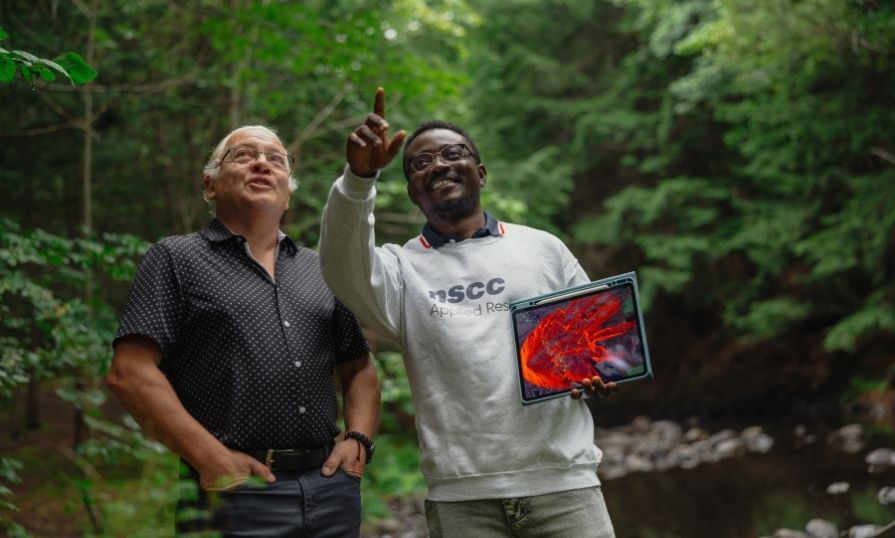
When Barry Stevens talks about his life’s work, he doesn’t start with technology. He starts with where he came from. Raised in poverty, first in a barn and then in a converted logging camp, Barry didn’t follow a conventional path into engineering and innovation.
Education came later. Over decades, driven by determination and long hours, Barry built a career grounded in applied engineering, national defence work and a simple philosophy: if something matters, it has to be useful.
That mindset led to the creation of FireGuardian, a wildfire prediction tool developed by his Nova Scotia company, Stevens Solutions & Design. He runs the company with his son Noah, an NSCC Screen Arts alum. But the story behind it begins somewhere else entirely, on the coast.
Seeing the problem differently
Years before FireGuardian, Barry was focused on another growing threat: coastal flooding and storm surge.
Living in Mahone Bay, he witnessed firsthand how misunderstood the risks were. During Hurricane Juan, for example, projected storm surges weren’t fully grasped by decision-makers or residents. Critical infrastructure and vulnerable communities, especially in coastal and First Nation areas, remained exposed. The issue wasn’t a lack of data. It was a lack of understanding.
“There were reports, maps and studies, good science,” Barry says. “But nobody was acting on it. Because they couldn’t see it.”
So, he and his son Noah built something different, 3D Wave Design: a way to translate complex science into immersive, interactive 3D visualizations. Instead of abstract maps, people could see their homes, roads and communities and how rising water would affect them.
The impact was immediate. “When people saw it, it became self-evident,” Barry explains. “Then action followed.”
That same approach, making complex science understandable and usable, would become the foundation for FireGuardian.
From water to wildfire
The idea didn’t come from Barry alone. While working with Indigenous communities on flood modelling, a federal partner posed the question, “Could this work for fire?”
At the time, the answer wasn’t obvious. Wildfires are far more complex than floods, driven by dozens of variables including temperature, wind, humidity, terrain, vegetation type and density. But there were mathematical models. And where there are models, Barry believed there’s a way to apply them. What followed was years of development, testing and refinement.
Today, FireGuardian can simulate how a wildfire may spread, in seconds, based on real-world conditions. It helps users answer critical questions:
- Where will the fire be in six hours?
- What areas should be evacuated?
- Where should crews focus suppression efforts?
- Is it safe to conduct a controlled burn today?
“It’s about being proactive instead of reactive,” says Barry.
The role of NSCC Applied Research
As FireGuardian evolved, Barry knew independent validation would be critical. He turned to a trusted partner: NSCC’s Applied Geomatics Research Group (AGRG).
“NSCC has street cred. AGRG has street cred. Dr. Tim Webster has street cred,” he says. “We needed someone who could test our product in a practical way and be completely impartial. NSCC didn’t give us an inch. That’s exactly what we wanted.”
AGRG brought scientific rigour, testing the software against real-world wildfire events, including the 2023 Shelburne fire. Their work helped confirm that FireGuardian could accurately simulate fire behaviour and provided critical feedback to strengthen the model. For AGRG researcher Lauren Douglas, the value is clear:
“There’s a big difference between having data and being able to act on it. Tools like this give communities the ability to generate insight in real time, instead of waiting for updates or relying on outdated systems. That speed matters, especially when a fire can shift direction in minutes.”
The results were striking. FireGuardian’s simulations closely matched the actual burn patterns, outperforming existing federal tools in key areas. For Barry, that kind of third-party validation was essential. For AGRG, it means showing the model doesn’t just work but holds up in real-world situations.
Student talent at work
Behind the scenes, students played a key role in advancing the work.
During his time as a student in NSCC's Geographic Information Systems and Full Stack Application Development programs, and while working as an AGRG research assistant, Mamadou Coulibaly contributed to the development of FireGuardian. His work focused on validating the model and testing its accuracy across different scenarios, including comparisons with existing industry tools.
“Unlike academic exercises, the outcomes of our work had real implications,” says Mamadou. “It pushed me to be more rigorous, detail-oriented and accountable.” Through this process, he developed a critical skillset that extends far beyond the classroom. “One of the biggest takeaways was learning not just to test something, but to question results, understand discrepancies and ensure reliability,” he explains.
Now working in the field, Mamadou still applies those same principles every day, showing how applied research experiences can shape careers while delivering real impact.
Bridging gaps together
FireGuardian is more than a piece of software. It’s the result of collaboration across industry, researchers and students, each playing a role in moving the work forward and bridging critical gaps.
- Industry brings the vision and urgency
- Researchers ensure scientific rigour and validation
- Students support real-world testing and develop career ready skills
That collaboration is critical when tackling complex challenges like wildfires. “No single discipline or organization can address these issues alone,” says Mamadou. “Bringing together different perspectives helps innovation happen faster and prepares the next generation to respond.”
This approach also reflects Barry’s Indigenous worldview, grounded in stewardship and shared responsibility.
Two-Eyed Seeing in practice
For Barry, the technology behind FireGuardian is only part of the story. The way it’s designed is shaped by a broader worldview rooted in Indigenous ways of knowing.
Drawing on the concept of Two-Eyed Seeing, the work brings together scientific modelling with lived experience, observation and community knowledge. “We’re part of the system, not separate from it,” he says.
That perspective shifts how problems are approached. Instead of seeing forests strictly as resources, Barry sees them as living systems that require balance and care. He points to traditional practices like controlled burning, used by Indigenous communities for generations to reduce risk, support wildlife and maintain healthy ecosystems.
“Nothing grows in a mature forest,” he explains. “Those burns created space for new life, for animals to feed, for the land to renew itself.”
That same thinking is reflected in FireGuardian. While the software can predict how wildfires spread, it can also be used to plan controlled burns safely and responsibly, helping communities take a more proactive approach to land management.
Two-Eyed Seeing also influences how information is shared. For Barry, it’s not enough for experts to understand the data. Communities need to see it, question it and make decisions together. “Give people the information,” he says. “Let them see it for themselves. Then they can decide what’s right.”
By combining scientific rigour with community understanding, FireGuardian is designed not just as a tool for experts, but as a way to support collective, informed decision-making.
Why it matters now
With increasingly severe wildfires across Canada, the need for better tools has never been more urgent. FireGuardian helps communities prepare earlier, respond faster and make smarter decisions. But its potential goes further. Because it can model risk, guide mitigation strategies and inform resource deployment, the technology is also gaining attention as a dual-use tool for national defence.
In simple terms, dual-use means a technology can serve both civilian and defence purposes. In the case of FireGuardian, it can help communities predict and manage wildfires, while also supporting military operations that respond to natural disasters and protect critical infrastructure.
In Canada, military forces are regularly called on to respond to natural disasters, including wildfires. Tools that help predict and manage those events become part of the country’s broader security framework.
“If you can understand the threat, you can respond to it or even prevent it,” Barry says.
A Nova Scotia solution with global potential
FireGuardian has reached Technology Readiness Level 9, meaning it’s been tested and proven in real-world conditions. It has also been accepted into the Government of Canada’s Pathway to Commercialization program, recognizing it as a high-potential solution ready for federal use.
The technology has been validated through national testing programs, including at Canadian Forces bases, and is now positioned to help protect critical infrastructure and communities from the growing threat of wildfires.
For Barry, a Mi’kmaq founder, that recognition matters. “It shows that Indigenous innovation can lead the way,” he says. But the work isn’t finished. “The challenge now is getting people to adopt it,” he says. “But it only takes one person to see it, to understand it and then it spreads.”
What began as an idea has grown into a high-potential solution. With collaborators like AGRG, the team continues to refine and test the technology as the work moves toward its next phase. The goal remains unchanged: to turn complex science into something people can use so they can understand risk, take action and protect what matters most.