
Environment and agriculture technology
Applied, collaborative research that strengthens food systems, improves soil health and advances sustainable agriculture in Nova Scotia and Canada.
The NSCC Applied Environment and Agriculture Technology Research Lab (EATLab) is a trusted applied research partner with a proven track record of collaboration across industry, funding agencies and research institutions. The EATLab team specialize in developing practical, science‑driven solutions that improve products, optimize processes and address complex business challenges.
Working alongside community partners, SMEs, producer organizations and innovative startups, we deliver decision‑ready, real‑world results that strengthen food security and accelerate sustainable agricultural innovation. Our projects are collaborative, well scoped and closely aligned with our core strengths, producing reproducible data and insights partners can trust.
Why work with us
Areas of expertise
- Plant stress responses: Research on plant responses to environmental stressors (e.g., drought, temperature, salinity) to improve resilience, productivity and decision‑making in production systems.
- Biostimulants and crop product testing: Independent testing of agricultural inputs (e.g., biostimulants, soil amendments) to generate reliable performance data for partners and producers.
- Tissue culture, plant propagation and cryotherapy: Controlled laboratory methods to support propagation, early‑stage testing and plant uniformity. Development and maintenance of disease‑free propagation lines for high‑quality starting material.
- Storage life and methods: Testing and development of improved storage techniques to extend product life and maintain quality.
- Soil science and soil health: Assessment of soil properties, biology and management practices to support nutrient cycling, carbon stewardship and sustainable crop outcomes.
- Sustainable agriculture systems: Evaluation of practical, scalable, climate‑smart approaches to environmentally responsible food and crop production.
- Cultural keystone plants and eco‑cultural research: Collaborative research centred on culturally significant plants and Indigenous knowledge systems, guided by community priorities and ethical research practices.
- Community plant ecology and food security initiatives: Applied, place‑based research focused on strengthening local food systems and community food security.
Facilities and equipment
Our labs and growing spaces support hands‑on experimentation, data collection and applied testing across plant and soil systems.
- GEN1000 Growth Chambers (8 units)
Fully programmable growth chambers with precise control of temperature (‑5 °C to 40 °C), CO₂ concentration, humidity and lighting, supporting year‑round controlled‑environment plant growth and stress experimentation. - 40‑foot growtainer
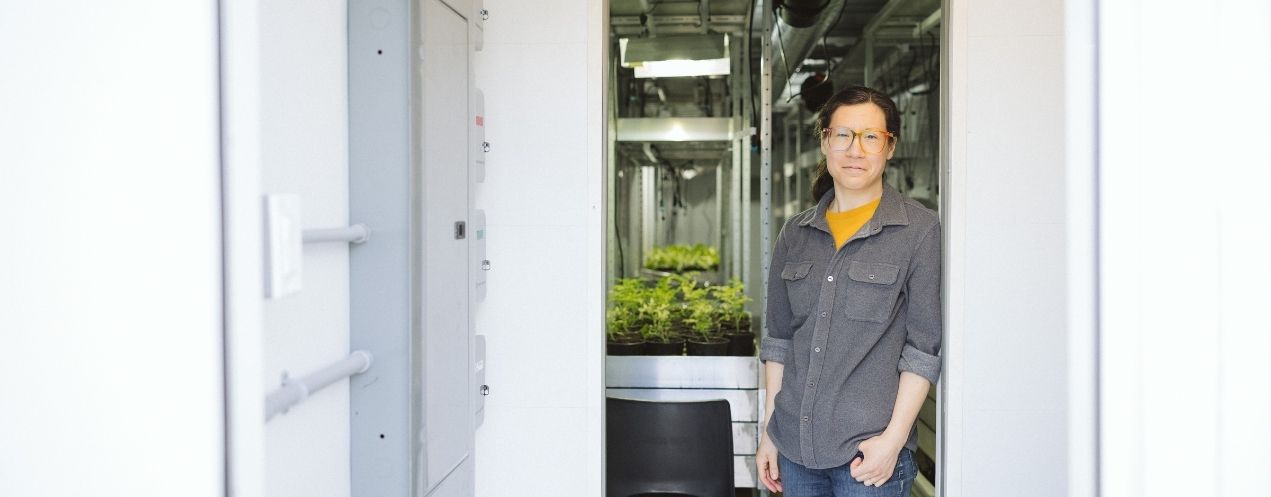
A containerized plant growth facility equipped with multi‑level shelving and environmental controls, enabling large‑scale propagation and semi‑controlled experimental trials. - Irrigated outdoor raised beds (15 units; 6’ × 4’)
Field‑based growing spaces with controlled irrigation for applied research, cultivar trials and validation of controlled‑environment findings under real‑world conditions. - KB BINDER 470 Incubators (3 units)
Versatile incubators with a temperature range of ‑20 °C to 40 °C, suitable for seed stratification, microbial growth and controlled physiological or biochemical experiments. - BOD Incubators (3 units)
Low‑temperature incubators (‑10 °C to 20 °C) designed for biological oxygen demand studies, seed germination tests and cold‑related experimental applications.
- LI‑COR LI‑6800 Portable Photosynthesis Systems (2 units)
High‑precision systems for detailed measurements of leaf‑level gas exchange and photosynthetic performance, equipped for simultaneous chlorophyll fluorescence. Interchangeable chambers support both broadleaf and conifer/needle tissues, enabling controlled physiological measurements under a range of environmental conditions. - LI‑COR LI‑600 and LI‑600N Porometer/Fluorometers
Handheld instruments for rapid, high‑throughput assessment of stomatal conductance and chlorophyll a fluorescence, ideal for field surveys and physiological screening of broadleaf and needle‑leaf species. - Refrigerated Circulator
Used for cold hardiness and freeze‑tolerance testing, providing precise temperature control for controlled stress experiments. - High‑Performance Liquid Chromatograph (HPLC)
Supports quantitative analysis of plant biochemical compounds, including pigments and stress‑related metabolites. - Chlorophyll Meter
Enables fast, non‑destructive estimation of leaf chlorophyll content for plant health and nutrient status assessments. - Leaf Area Meter
Provides accurate measurements of leaf surface area for growth analysis, physiological scaling, and trait‑based studies.
- Elementar Enviro TOC/TN Analyzer
High‑precision system for quantifying total organic carbon and total nitrogen in soils and water, supporting soil health assessment and nutrient cycling studies. - ThermoFisher FlashSmart NC Soil Elemental Analyzer
Automated elemental analyzer for rapid determination of carbon and nitrogen content in soil and plant materials. - pH and Conductivity Meters
Portable and benchtop instruments for measuring soil and water acidity and salinity, essential for nutrient availability and irrigation management assessments. - Lysimeters
Systems for collecting soil water and leachate to quantify nutrient movement, water balance and below‑ground losses under controlled and field conditions. - Soil moisture readers
Handheld sensors for rapid, non‑destructive measurement of soil water content, supporting irrigation scheduling and drought‑stress research.
- Thermocycler
Standard PCR system for DNA amplification in genotyping, cloning and marker‑based studies. - Qubit Flex Fluorometer
High‑sensitivity fluorometric platform for accurate quantification of DNA, RNA, and protein samples. - ProFlex PCR System
Advanced thermocycler with flexible block configurations, enabling simultaneous amplification protocols across different assay types. - QuantStudio 5 Real‑Time PCR System
Real‑time quantitative PCR instrument for precise gene expression analysis and molecular diagnostics. - E‑Gel Power Snap Plus Electrophoresis System
Integrated gel electrophoresis and imaging platform for rapid DNA and RNA fragment analysis. - NanoDrop Spectrophotometer
Microvolume spectrophotometer for fast assessment of nucleic acid and protein concentration and purity.
- Laminar flow hoods (2 units; 5‑ft)
Sterile workstations providing HEPA‑filtered airflow for aseptic plant tissue culture and sample preparation. - BioClave 28 autoclaves (2 units)
High‑capacity benchtop autoclaves for sterilization of media, instruments and laboratory consumables. - Cryostorage tanks and dry shipper (2 units)
Liquid nitrogen–based systems for long‑term preservation and safe transport of plant germplasm and biological samples. - Controlled‑rate freezer
Precision freezing system that regulates cooling rates to optimize cryopreservation outcomes. - ‑80 °C freezer
Ultra‑low temperature storage for long‑term preservation of nucleic acids, enzymes, metabolites and other sensitive biological materials.
- Atago pH and Brix Meters (2 units)
Handheld instruments for rapid measurement of fruit acidity and soluble solids, supporting maturity, flavor and quality evaluations. - Firmness meter
Mechanical tester for assessing fruit texture and resistance, key indicators of ripeness and post‑harvest quality. - High‑performance liquid chromatograph (HPLC)
Analytical platform for quantifying sugars, organic acids, pigments, and other quality‑related compounds in fruit tissues. - BioTek multiplate reader
Multi‑mode plate reader for absorbance, fluorescence, and luminescence assays in biochemical and quality‑related analyses.
- Industrial centrifuge
High‑capacity centrifuge for rapid separation of cells, tissues and extracts in molecular, biochemical, and physiological workflows. - 3D printer for plastics
Additive manufacturing system for producing custom laboratory components, holders, adapters and experimental prototypes.