
Ocean innovation - SEATAC
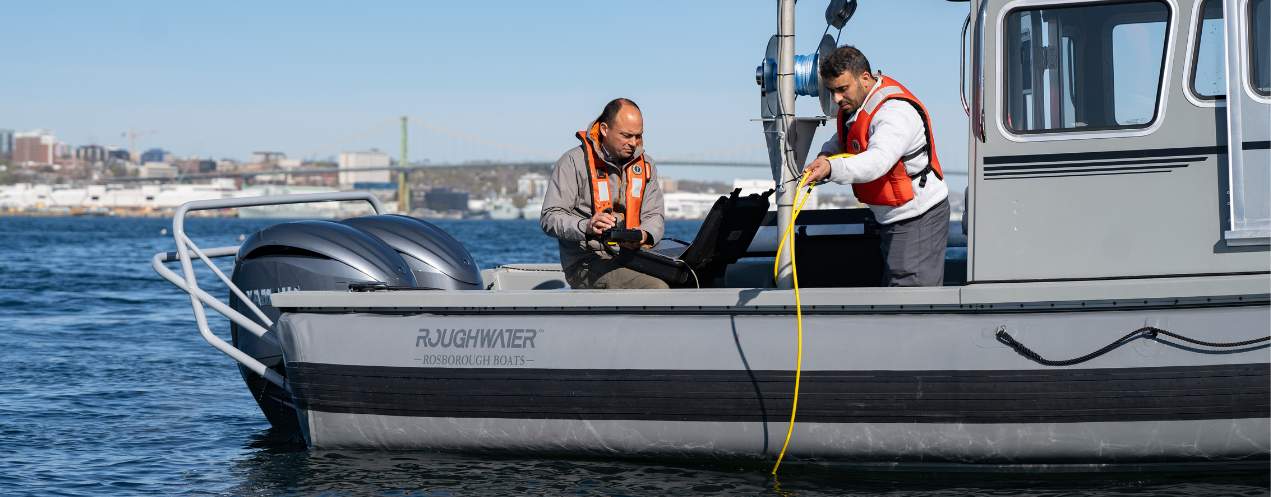
Advancing innovation through prototype development, on-water validation and engineering support.
SEATAC is a Technology Access Centre focused on marine and ocean technology innovation. Working with companies, startups, government and research organizations, we help bring ideas from concept to deployment through prototype development and on-water validation. Our team of engineers and technologists delivers practical, results-driven solutions that reduce technical risk, accelerate commercialization and solve complex research and development (R&D) challenges.
Co-located at COVE, a shared space for marine technology organizations, and NSCC Ivany Campus, SEATAC provides partners with access to specialized facilities, advanced equipment, and staff and student researchers. We work collaboratively to deliver well-scoped projects, producing validated technologies, data-driven insights and decision-ready outcomes partners can trust.
Why work with us
Areas of expertise
- On‑water testing and field trials: Field testing of marine equipment and instrumentation in real-world ocean conditions, including performance verification, environmental exposure and operational reliability.
- Technology validation and transfer: Independent validation of ocean technologies to support commercialization, adoption and scaling across industry applications.
- Non-destructive inspection: Advanced inspection techniques to assess structural integrity and detect defects without damaging components.
- 3D design, modelling, prototyping and simulation: Digital design and simulation tools to accelerate development, optimize performance and reduce risk.
- Reverse engineering: Analysis and reconstruction of existing systems or components to support redesign, improvement or replication.
- Data acquisition systems: Design and deployment of systems to collect high-quality environmental and operational data.
- Manufacturing systems and electromechanical design: Integration of mechanical, electrical and control systems for robust, field-ready solutions.
- Additive manufacturing: 3D-printing using metals, polymers and composites to enable rapid prototyping and complex geometries.
- Advanced welding and fabrication: Specialized arc welding processes and fabrication techniques for marine and industrial applications.
- Composite design and manufacturing: Development of composite structures, including tooling design and production for lightweight, durable components.
- Manufacturing automation and robotics: Integration of automated systems and robotics to improve efficiency, precision and repeatability.
Facilities and equipment
- Rosborough 9.11 m RHIB (research vessel): Crewed inshore and nearshore vessel designed to support marine research, technology deployment and field operations.
- OceanServer IVER2 Autonomous Underwater Vehicle (AUV): Autonomous platform for coastal survey, seabed mapping and environmental monitoring.
- VideoRay Pro 3 Remotely Operated Vehicle (ROV): Compact underwater vehicle for visual inspection, survey work and shallow-depth exploration.
- Towed body system: Instrument deployment platform designed to minimize vessel interference, enabling high-quality data collection.
- AML Oceanographic Moving Vessel Profiler (MVP): System for continuous water column profiling and hydrographic surveying.
- Sea-Bird Scientific CTD Rosette / Carousel: Integrated system for water sampling and measurement of conductivity, temperature, depth and fluorescence.
- Acoustic Zooplankton Fish Profiler (AZFP): Acoustic sensor used to monitor zooplankton and fish distribution within the water column.
- Teledyne RD Instruments S100 ADCP: Acoustic Doppler profiler for measuring currents, waves and supporting underwater navigation.
- SG-DX-20 Double Van Veen Grab: Equipment for collecting sediment samples from the seafloor for environmental and geotechnical analysis.
- Renishaw AM250 metal additive manufacturing system: Industrial 3D printing for complex metal components across a range of materials.
- Formlabs Form 2 SLA 3D printer: High-resolution resin printer for producing detailed, functional and waterproof components.
- Markforged Mark Two composite 3D printer: Continuous fiber-reinforced printing system for strong, lightweight nylon composite parts.
- FARO ScanArm: High-precision 3D scanning system for reverse engineering, inspection and digital model development.
- Omax ProtoMAX CNC waterjet table: Precision cutting system for a wide range of materials, supporting prototyping and fabrication.
- Robotic arm: Programmable system for automated assembly, fabrication and repeatable manufacturing processes.
- Global Scuba Pressure Test Chamber: Controlled pressure system used to evaluate equipment performance, watertightness and resistance under simulated depth conditions.
Project examples
SEATAC is developing a user-friendly renewable energy calculator to help off‑grid fishing wharfs compare microgrid options and make informed energy decisions with confidence.
Designing and building a tool to test sustainable marine coatings
A custom rotating paint wheel developed by SEATAC is helping GIT Coatings test and refine their sustainable graphene‑based marine coatings by simulating real ship speeds in controlled conditions.
A new mount is enabling SEATAC’s Moving Vessel Profiler to collect high‑resolution ocean data during at‑sea testing. Developed in close collaboration with pHathom Technologies, the project supports advancing carbon dioxide removal innovation.
Service streams
Ready to start a project?
Complete our project intake form to get started