
Turning groundwater data into community knowledge
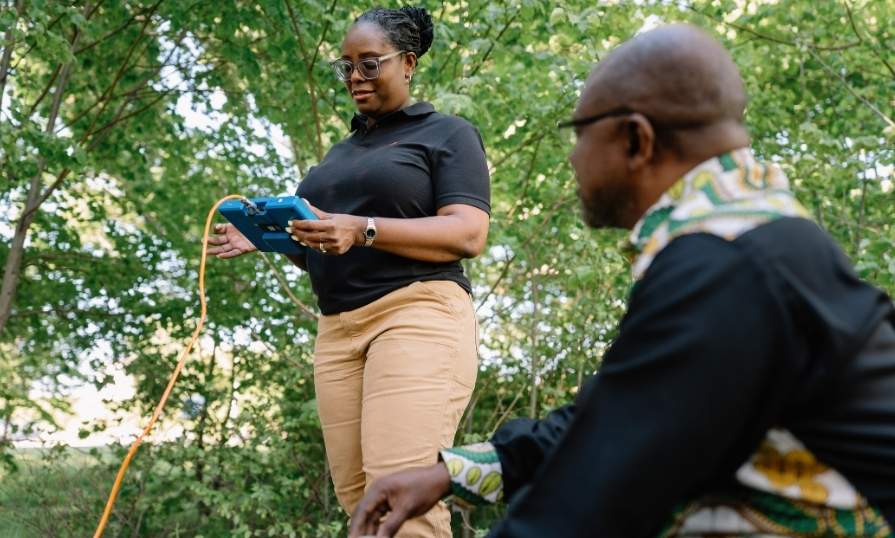
In Nova Scotia, nearly half the population—about 46 per cent—relies on private wells for their drinking water. Unlike municipal systems, these wells are not routinely monitored, leaving homeowners responsible for maintenance and water quality testing. For many, that means limited information about what’s in their water and how environmental changes may be affecting it.
A new collaboration between NSCC Engineered Technologies Applied Research, the Upper Hammonds Plains Community Land Trust and SimplyCast is working to change that. Together, they have developed a community-driven platform that helps residents better understand their groundwater through accessible, real-time data and mapping.
From data to decisions
The project translates complex groundwater information into practical tools, including clear maps, charts and alerts that show how water levels, temperature and quality are changing over time. The goal is to give residents the knowledge they need to make informed decisions about their own water.
NSCC graduate from the Environmental Engineering Technology - Water Resources program Alecia Atkinson, now a college researcher who supported community engagement and water testing as part of the project, explains:
“Many households rely on private wells as their primary source of drinking water yet may not fully understand the quality and sustainability of their groundwater. This project helps close that gap by building awareness and providing data, education and community engagement that empower people to take informed action and strengthen long-term preparedness.”
The project is part of a broader research initiative focused on water resource management under climate change. Environmental shifts like drought, heavy rainfall and seasonal variability can impact both the availability and safety of groundwater. Without regular monitoring, issues can go undetected for years.
That risk became clear during the project’s water testing phase. In some cases, results revealed unexpected water quality concerns, highlighting hidden risks residents may be unaware of, even after years of relying on private wells.
With support from the project team, affected households were connected to appropriate resources to better understand their results and determine next steps.
“It really opened people’s eyes and reinforced the need for accessible information so persons can make informed decisions about their drinking water,” says Alecia.
Building trust through community partnership
Beyond individual cases, the project focused heavily on building trust and awareness within the community. Early engagement efforts saw limited participation, but that changed as researchers and community partners hosted in-person presentations, explaining the risks and benefits of participating.
“Once people understood that this was about helping them, not just collecting data, they became much more interested and engaged,” Alecia said.
That community-first approach was key to the project’s success. Working closely with the Upper Hammonds Plains Community Land Trust, a Black-led organization, ensured the work was grounded in local priorities and built on existing relationships.
The result is not just a research project, but a collaborative model where community members play an active role in understanding and managing their own resources. A locally hired community liaison, Alaura Timmons, helped bridge communication, share information and build trust, ensuring the work remained accessible and relevant.
For Alaura, that role underscored both the importance of community involvement and the need for clear, accessible data:
“Being involved in the project showed me the important role community members can play in collecting scientific data, but also how critical it is to communicate results in real time and in ways people can understand. Our community values being included and informed about groundwater so we can use that information to raise awareness and help protect our shared resources.”
The technology itself is designed with accessibility in mind. Using SimplyCast’s interactive mapping platform, users can explore groundwater trends, like changes in water levels and temperature over time. In some areas, well monitoring devices provide near real-time data through a connected dashboard, giving users an ongoing view of their well conditions.
Together, these tools transform complex scientific data into a clear, visual baseline — a groundwater “fingerprint” for the area that can help detect changes over time.
Developing the next generation of researchers
Applied research projects like this one provide students and recent graduates with opportunities to work on complex, real-world challenges while developing valuable technical and professional skills. Students and recent graduates from NSCC played a critical role in bringing the project to life by designing and building monitoring devices, conducting field surveys and supporting data collection. By applying the skills learned in the classroom to real-world settings, they gained hands-on experience in environmental monitoring, engineering, data analysis and community-based research.
Stefan Wakata, a recent Mathematics and Computer Science graduate from the University of Ottawa who contributed to the project, reflected on the experience:
"This project taught me that the best code is the kind that solves a real problem for real people. Monitoring 14 wells across Nova Scotia and building an AI assistant that researchers could actually talk to showed me how technology can make a meaningful impact. There's something humbling about seeing everything you've learned come to life in a context that truly matters. From contributing as part of the research team to presenting to stakeholders in support of rural water resilience, I am proud to be part of the NSCC-CCSIF groundwater monitoring team."
A model for resilient communities
For Alecia, one of the most important outcomes goes beyond the technology itself. It is about building awareness and long-term resilience.
“If people aren’t aware of what may be affecting their water quality, it becomes difficult to take appropriate action,” she said. “This project is about sharing knowledge, building that awareness and supporting communities so they can make informed decisions.”
While the initial phase of the project is now wrapping up, its impact is expected to extend far beyond Upper Hammonds Plains. The model, combining applied research, community partnership and accessible technology, has the potential to be replicated in other communities across Nova Scotia.
Ultimately, the project demonstrates how research and local knowledge can come together to address real-world challenges, transforming data into understanding and understanding into action.
Because when it comes to water, Alecia says, the stakes are simple: “Water is life.”