
New Applied Research Lab at Sydney Waterfront Campus
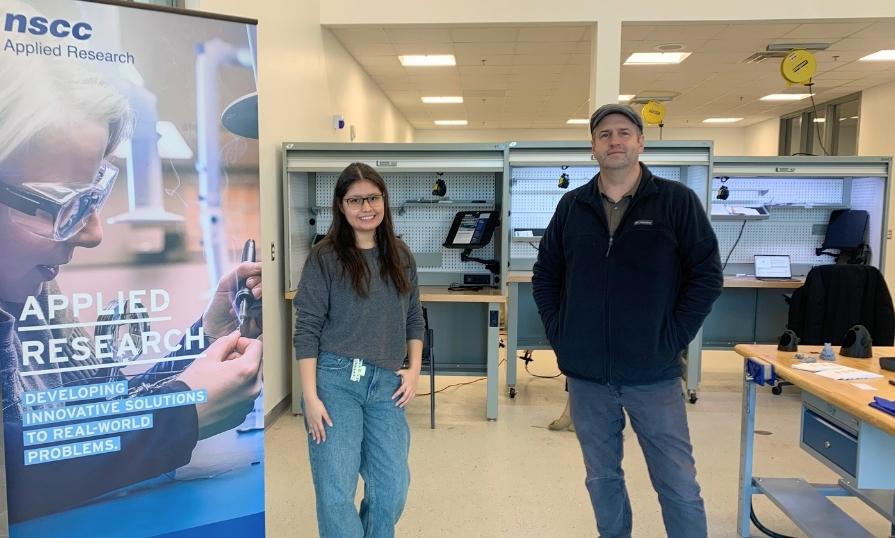
The Sydney Waterfront Campus (SWC) is taking a bold step toward fostering innovation and collaboration with the launch of its new Applied Research Lab. This dedicated space connects students, faculty and industry partners, creating a hub where ideas transform into real-world solutions that drive regional innovation.
Matt Swan, Research Specialist at SWC, sees the Lab as a gateway for local businesses to access NSCC’s extensive resources. “Developing a new resource for this campus and community is what I find very exciting,” says Swan. “For students and industry to have a physical location to come and talk about their ideas and the resources available within NSCC’s network to support those ideas is a game-changer.”
The Lab’s flexibility is key. While its future areas of specialization, such as engineering, manufacturing, healthcare or defence, will evolve over time based on demand, the immediate focus is on providing practical support for innovation. Current projects include business automation, technology transfer and food security initiatives, giving students hands-on experience in AI automation, drone operation and rapid prototyping.
Student-led solutions for real-world challenges
One of these projects, JUSTgrow, is led by Camila Del Aguila Chang, a Business Administration student at SWC. Camila is the recipient of the David Lane Memorial Applied Research Grant, a $3,000 award for a student whose project showed the most connection to sustainability, clean technology or climate change.
Her work focuses on aeroponic farming systems to address food insecurity in Cape Breton. “The inspiration for JUSTgrow came from seeing how climate change and food insecurity affect Cape Breton,” Camila explains. “Extreme weather makes it harder to grow food locally, so we need practical approaches to support year-round food production.”
Aeroponics stood out as a solution because it uses minimal water, requires no soil and can operate indoors during harsh seasons. “Access to the research lab and funding has expanded what this project can actually achieve,” she adds. “Without these resources, it would have stayed mostly theoretical. With the lab, I can build a real prototype, test how it performs and collect my own data.”
Camila hopes her research will inspire others to see that innovation doesn’t have to be complicated or expensive. “Even a small, low-cost prototype can show what’s possible when we look for new ways to grow food locally in a changing climate,” she says.
Building confidence through applied research
Applied research isn’t just about technology, it’s about building confidence and an entrepreneurial mindset. “When students or business owners see their own ideas incorporated into solving real problems, a certain courage and confidence develops,” Swan notes. “Cultivating this innovation, courage and confidence in a population is critical for growth, and I believe that an Applied Research Lab here in Sydney can play a crucial role in that process.”
The Lab benefits from programs like the SPRINT microgrants and the David Lane Memorial Applied Research Grant, which fund early-stage projects and encourage sustainability-focused innovation. These initiatives ensure students work on projects that matter for the future of our communities and planet.
As Sydney’s economy evolves, the Applied Research Lab positions the campus as a hub for technology, sustainability and advanced manufacturing. By connecting research to industry needs, the Lab helps businesses stay competitive while creating opportunities for students to contribute meaningfully to the region’s growth.