
NSCC team makes Canadian history at global floating wind competition
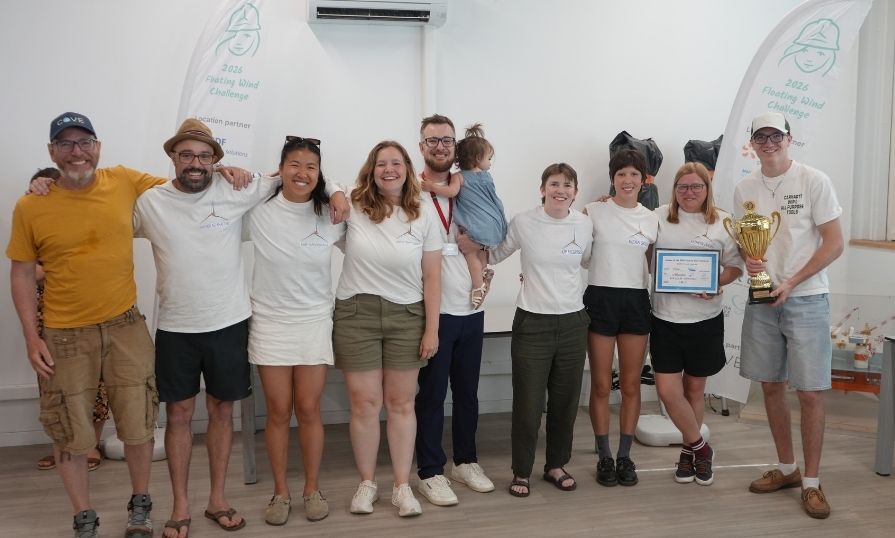
The Scotian Gales, a multidisciplinary team of NSCC students and new graduates, made history as the first Canadian team to win the Global Floating Wind Challenge hosted by the Belgium-based not-for-profit OffshoreWind4Kids.
In February 2026, the Scotian Gales won COVE’s annual Canadian Floating Wind Challenge at the RelyOn Nutec simulation theatre in Dartmouth, earning them a spot on the global stage.
Competing against 12 teams from 10 countries, the Scotian Gales’s innovative design won first place for best structure and received a special award for safest operations at the Global Floating Wind Challenge in France.
“Our team worked incredibly hard over the last nine months to create a structure that was both practical and innovative in advancing platform technology for offshore turbine structures,” says Adrien Smith, NSCC Mechanical Engineering Technology student.
Both floating wind challenges tasked post-secondary students with designing floating structures for wind turbines, while also learning about offshore wind energy.
“The competition in France was exciting and intense. Our team was completely focused and in sync, and it was amazing to connect with students from around the world and see how they approached similar challenges,” says Shay Vanderbrugge, NSCC Electrical Engineering Technology student.
Dynamic team
While faculty initially introduced the students to the competition, the group signed up on their own and worked on the project outside of class.
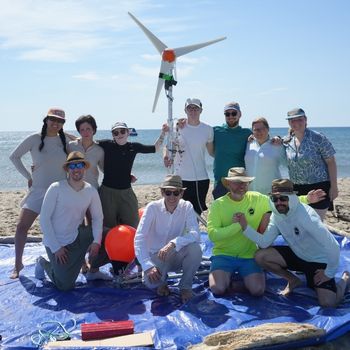
The Scotian Gales dedicated countless hours to research, meetings, whiteboard drawings and field testing in NSCC’s Oceans Technology room and at Rainbow Haven Beach.
“For the past nine months we have worked together to design, build, test and successfully deploy a tension leg platform system for a 500W turbine to be deployed in the ocean,” says Shay.
The eight-member team included students from four NSCC programs: Electrical Engineering Technology (Shay Vanderbrugge, Nicholas Khattar and Kiera Souza), Oceans Technology (Kaitlyn Lindholm), Mechanical Engineering Technology (Bryden Surrette, Kathryn Jansen and Adrien Smith) and Electronic Engineering Technology (Kip McGregor).
“Having people from different educational backgrounds, a variety of ages, a range of disciplines and people who had previous professions beforehand is partly why we were able to get where we did. With everybody's lived experiences coming together, we had so many more innovative options and opportunities,” says Shay.
The team divided and conquered, applying their program knowledge to the model, from structural design to buoyancy calculations, while teaching themselves other skills along the way.
Their design was inspired by the Tension Leg Platform concept and features a versatile, reconfigurable structure that allows real-time adjustments to buoyancy and mooring based on environmental conditions.
Community support
Shay says one of the team’s biggest advantages was having teammate Bryden Surrette, a machinist, design custom knuckles and pieces rather than relying on off-the-shelf materials.
To create the pieces, the team connected with the Machining faculty at Akerley Campus, who incorporated machining pieces for the model into a student project.
The team’s mentor was Ocean Technology faculty member Stephane Kirchhoff, who Shay describes as “encouraging and dedicated to our team. He spent so much of his own time with us, from late nights on campus to field testing on the weekends.”
Industry and community partners helped make it possible for the Scotian Gales to compete at the Global Floating Wind Challenge in France.
Following the team’s national success, COVE and its funding partners RBC and Nova Scotia Department of Energy provided sponsorship and resources. Additional support for the competition and team travel came from NSCC Foundation’s Extraordinary Learning Fund and the Nova Scotia Advisory Council for the Status of Women.
“We’re proud to see a Nova Scotian team representing Canada on the global stage. Seeing more women participate and succeed in STEM helps break down stereotypes, inspires others to see themselves in these fields, and creates opportunities for women’s future economic security,” says Leah Martin, Minister responsible for the Advisory Council on the Status of Women, Minister responsible for Youth, Minister of L’nu Affairs.
A growing industry
Offshore wind energy uses turbines at sea to generate electricity. With one of the world’s longest coastlines, Canada is well positioned to partake in the global the offshore wind sector.
Atlantic Canada, especially Nova Scotia, is moving to develop its first projects. Recognizing the province’s considerable offshore wind potential, the Government of Nova Scotia set a target in 2022 to offer leases for up to 5 gigawatts (GW) of offshore wind by 2030.